5th March 2024
To download this briefing as a pdf click here
Key points
- Oxfordshire County Council is consulting on its draft Vision Zero strategy, which aims for zero road deaths and reported serious injuries by 2050, with a 50% decrease by 2030.
- The strategy aims to embed Healthy Streets and Vision Zero principles and is linked to transport strategies committed to traffic reduction, but is:
- 1. Impeded by the lack of engagement by Thames Valley Police. This has major implications for speed enforcement and careless driving.
- 2. Still focused on road safety education rather than road danger reduction.
- Action Vision Zero (AVZ) has highlighted the actions that are welcomed as well as areas of concern.
- Consultation closes 10th March. Please do respond.
Draft Oxfordshire Vision Zero Strategy
As noted in the strategy, Oxfordshire has:
- A population of 750,000 population covering one city, 26 towns and 584 villages.
- An annual average of 30 road deaths, 245 serious injuries and nearly 1,250 slight injuries reported.
- 2,600 miles of roads and 175 miles of cycleway routes.
Oxfordshire has already adopted a target of zero road deaths and serious injuries by 2050, with a 50% reduction by 2030. This was in their Local Transport and Connectivity Plan (2022). This draft Vision Zero strategy goes further and proposes to bring this target forward to 2030 for the higher density urban areas.
Safe Systems is multi-sectoral so police are needed
To deliver Vision Zero, the county council has adopted the Safe Systems approach which recognises that a shared responsibility exists with those who design, build, manage and use roads and vehicles to prevent collisions resulting in serious injury or death. Thus, the police are a key partner. But Thames Valley Police (TVP) has failed to engage with the development of the regional Vision Zero strategy. This is unusual for the police, as highlighted in our Roads Policing and Vision Zero briefing which reviewed five Vision Zero strategies. All were either joint plans with the police or had the police as a key partner.
The police should have engaged. Oxfordshire County Council has made efforts to consult widely and included local active travel and national road danger reduction campaigners (AVZ is one of the stakeholders). And whilst the TVP Police and Crime Plan (2021-2025) had minimal reference to road safety, the Police and Crime Commissioner did include road safety and speeding within his priority of Strong local policing. He also pledged to develop a roads policing strategy which is yet to be completed.
For comparison, look to Surrey where they are also consulting on a draft Vision Zero strategy. Lisa Townsend, Police and Crime Commissioner for Surrey (also the PCC national road safety lead) states in the draft strategy’s foreword how:
The Surrey RoadSafe Vision Zero Road Safety Strategy represents a substantial opportunity to work collaboratively with key stakeholders, providing a comprehensive five-pillar approach to reduce risk, enhance road safety, and protect the lives of our residents. I commend the strategy and look forward to working with our partners across Surrey in making our roads safer for everyone to use.
More road danger reduction required
The Safe Systems approach adopted by Oxfordshire is organised into safe roads/safe roadsides, safe speeds, safe vehicles, safe road users and post-collision response.
AVZ has called for strategies to be based on road danger reduction, as in London. This prioritises reducing the dominance of motor vehicles and the associated harm by:
- Motor vehicle traffic
- Motor vehicle speed
- Road danger (injury and intimidation).
This is wider than many Vision Zero strategies which are restricted to reducing the number of people killed and seriously injured and do not address the wider public health and environmental harms from motor vehicle use.
Traffic reduction
Safe Roads and Roadsides
The safe roads actions includes reducing traffic. The need for traffic reduction has already been accepted by Oxfordshire County Council. This includes their Strategic Plan which has the climate emergency at its heart, and the Local Transport and Connectivity Plan (LTCP) which, in addition to the Vision Zero targets, aims to reduce one in four current car trips by 2030 as well as deliver a net-zero transport network by 2040.
The strategy proposes providing Healthy Streets training for its officer decision makers (SR2) and designers; this is welcomed. This should be extended to police and other key partners to ensure a shared understanding of the desired outcomes. The Council has also stated it will review all its highway design policy, guidance, standards and procedures to ensure alignment with the Vision Zero Strategy (SR3 and SR6). This is welcome and the Council should publish a summary of the changes that result from this review.
Speed reduction
The Safe Speed section aims to both reduce both speed limits and improve compliance. Key actions include:
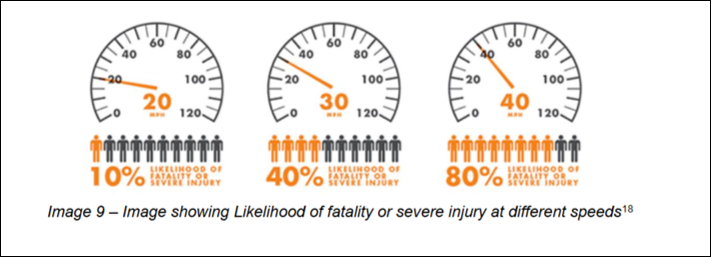
20mph. The strategy references 20mph as a safe speed for roads shared with people walking and cycling as this carries a 10% risk of death or severe injury for a pedestrian in a crash (see graphic below (page 29)). Oxfordshire is committed to rolling out 20mph to the vast majority of its towns and villages (82%), but it is these shared main roads which carry the highest risk and the greatest need for reduced speed.
Speed enforcement. In 2022, over 200,000 speeding offences were issued by TVP. Not one of them was in a 20mph limit, although 63% were in 30mph limits. In London, there is now significant 20mph enforcement, with a key reason being that TfL is adopting 20mph widely across its road network. So, the cameras on formerly 30mph roads are now enforcing 20mph limits.
And whilst some police services, like in Northamptonshire and London publish data on motoring offences, this data had to be collected by an FOI by 20’s Plenty for Us. Greater transparency as well as commitment is needed from TVP.
The strategy proposes greater use of Average Speed Cameras and mobile cameras, whilst over half of speed enforcement in Thames Valley came from fixed cameras in 2022. The strategy also includes supporting Community Speedwatch. In London, in addition to Community Speedwatch, council officers are able to request (and receive) speed enforcement at sites of community concern. Mobile speed enforcement teams are allocated to this.
Speed limiters. The strategy proposes to support the use of speed limiters on buses and public service vehicles. It would be better to commit to requiring their use, if even over a period of time.
Speed monitoring. It is good that a Safe Speeds monitoring programme is to be developed but this data should be shared with the public so they are better aware of vehicle speeds.
Road danger reduction
Safe Vehicles
Commercial vehicles. The strategy acknowledges the increased risk posed by lorries and buses and contains several actions targeting them, including Direct Vision Standard and FORS for lorries. Tackling the problem of close passes with the bus industry, as well as speeding, is good to see.
Safe Users
Education. The strategy aims to expand and enhance their road safety education programmes where possible (SU1). This is despite the Safe Systems approach acknowledging that humans make mistakes and should not be expected to be infallible. Responsibility is required to be more on the transport system operators and managers.
Highway Code changes. The strategy proposes working with national government (the Department for Transport (DfT))to increase awareness of the recent Highway Code changes (favouring those who are walking and cycling). But more can be done at the local level, with publicity campaigns, without waiting for DfT.
Traffic law enforcement. The strategy references the online reporting system operated by TVP and includes the action to Engage with Vision Zero partners to establish Safe Users resources, for reporting unsafe driving, near-misses, or close-passes (SU5). This is to be applauded. Likewise, the strategy acknowledges that other police services have included careless driving as a priority. The Council should recognise it as a key priority offence, and work to get TVP to follow.
Post Collision Response and Learning
Advocate for justice. The strategy states it will “advocate for justice for victims of road collisions where there is crime or other culpability”. This commitment is appreciated. The Council should work with personal injury solicitors on this as they will also be advocating for victims and have wide experience.
Collision investigation. The Council is to be commended for its inclusion of collision investigation, a key area for active travel campaigners. With people walking and cycling being more at risk of being seriously injured, it is important that the state responds properly and investigates these collisions thoroughly. No Further Action reviews are needed to gain the confidence of vulnerable road users, especially cyclists.
General concerns
Three key concerns deserve mention:
Subjective safety. Feeling safe is a key indicator of Healthy Streets as if people feel unsafe, they will not walk or cycle. Whilst the reduction in the numbers of people being killed and seriously injured is the main aim, there is no mention of reducing the perception of danger, which is enough to deter people from cycling and walking more. If this cannot be monitored, then proxy indicators, e.g. share of women cycling, should be used.
Funding. The £4m allocated to date has been assigned to various workstreams which do not appear to cover all actions in the strategy. The Council has stated it will “aim to look for additional funding streams” in order to avoid making safety compromises (SR5). Much rests on this uncertain financial situation.
Performance indicators. The strategy includes outcomes and performance indicators but these are not quantified so it is not possible to know how ambitious they are. This needs to be corrected. And indicators should better reflect reducing road danger. For instance, one (of three) Safe Vehicles indicator is the percentage of new passenger cars with highest Euro NCAP safety rating registered in Oxfordshire (P6). A better one would be the percentage of buses with speed limiters.
Likewise the sole indicator for Post Collision Response is the proportion of emergency medical services arriving at scene of a collision within 18 minutes of notification (P13). Another indicator should be the percentage of No Further Action charging decisions upheld upon review.
AVZ conclusion. Oxfordshire Vision Zero strategy is building on a good base but the support of TVP is essential, especially with speed enforcement and online reporting. There also needs to be greater commitment to reducing the harm posed to people walking and cycling, with performance indicators reflecting this.
 actionvisionzero.org