17 June 2024
To download this briefing as a pdf click here
Key points
- This draft action plan contains no concrete actions and asks for feedback on what they describe as “some actions for Greater Manchester may include”.
- The target is to have zero road deaths and life changing injuries by 2040.
- It is based on the Safe System Approach but misses opportunities to design out danger, and does not prioritise reducing harm posed to people walking and cycling.
- Key areas are overlooked including the need to move towards a 20mph default speed limit across Greater Manchester, the importance of reducing traffic volumes overall and the impact that reducing through traffic on neighbourhood streets (eg with LTNs) can have to reduce casualties.
- It could and should be better, given that the plan can learn from other UK cities (and global best practice), inc. London and Leeds.
- If you travel in Manchester, please respond (consultation closes 27 June) and demand more from this action plan. See our suggestions below. What is proposed is not enough to reduce road danger and get people out of their cars.
So Greater Manchester is consulting on its first Vision Zero Action Plan, covering 2024-2027. Coming some six years after London’s Vision Zero Action Plan and two years after Leeds, this plan should be bold and better informed.
Instead it is short (10 pages) and superficial. Based on the Safe Systems Approach, it is organised by the standard five pillars (Safe Speeds, Safe Roads, Safe Road Users, Safe Vehicles, and Post Collision Response) but only offers “Some actions for Greater Manchester may include” for each of these pillars. This is not good enough.
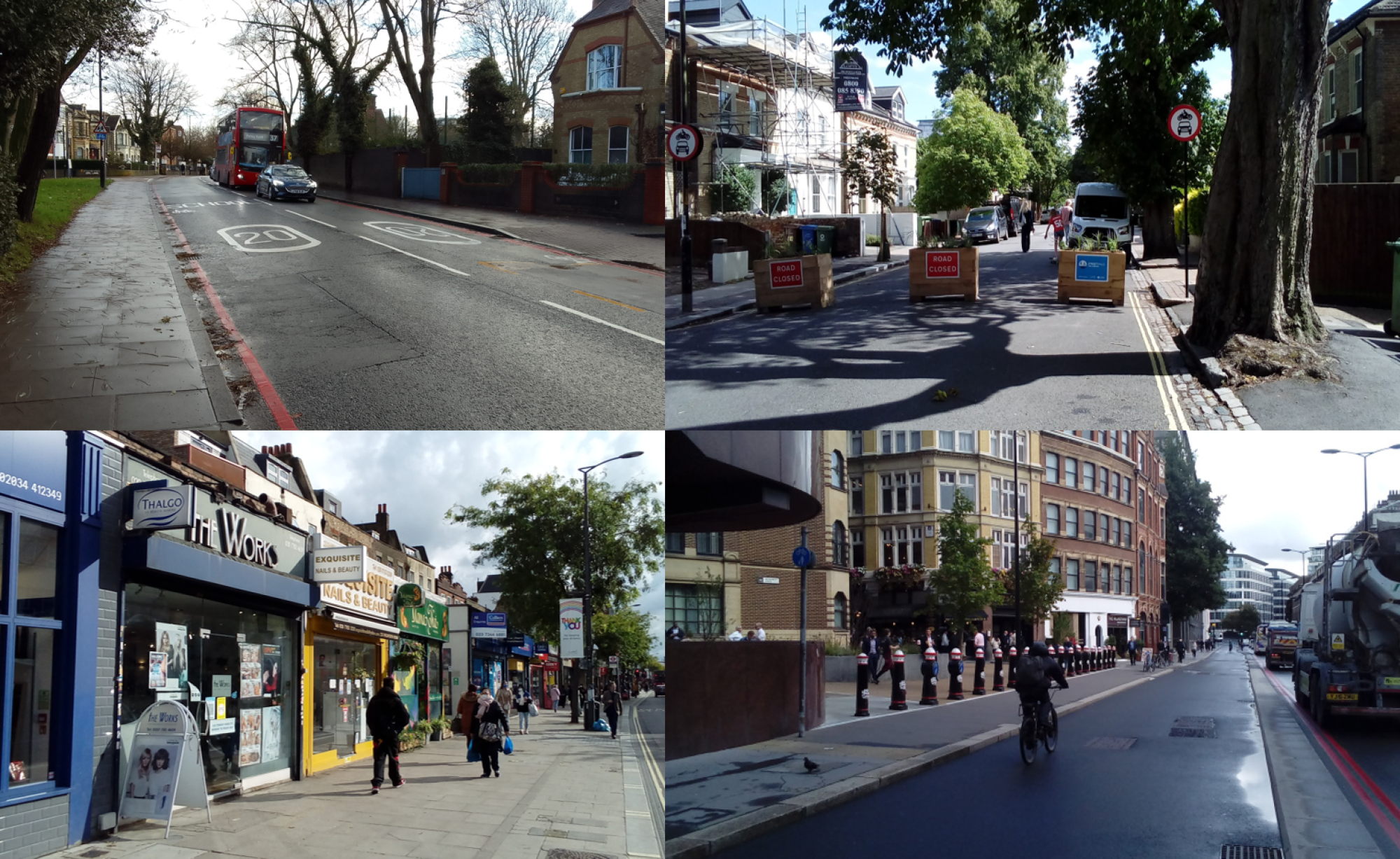
Here Action Vision Zero highlights our key concerns with this action plan and opportunities for improvement. Our feedback is based on the experience in London, where the original Vision Zero plan was updated some three years ago and is due a refresh, as well as several other Vision Zero plans in the UK which we have reviewed.
Safer Roads Benefit Everyone
The plan begins with an introductory section. But it references motor vehicle casualties before vulnerable road users, despite the latter accounting for almost twice as many casualties. And the impact on the NHS is described as only being from major trauma injuries with no reference to the reduction in obesity and inactivity-related disease if more people chose active travel modes, nor the possible reduction in air pollution related morbidity if driving reduced.
So, this it is not a plan based on road danger reduction (as in London). No mention is made of the need to reduce traffic for public health or environmental reasons. No priority appears given to reducing harm posed to people walking or cycling.
Safe Speeds
If Manchester is at all serious about eliminating deaths and life-changing injuries, then vehicle speeds must reduce. Pedestrians have a 50% chance of a severe injury if hit at 31 mph, compared to 25% at 23 mph. (AAA, 2011). And even 25% seems unacceptable.
So, it is good to see Safe Speeds be the first pillar addressed but the possible actions are limited.
For any authority that is serious about Vision Zero and Road Danger Reduction, the default speed limit in built up areas should be 20mph. Of the ten Local Authorities that make up the Greater Manchester Combined Authority, six have moved to a default 20mph limit[1] while four, Oldham, Tameside, Salford and Trafford have not. The draft Action Plan has no mention of “20mph” and does not state that it is advocating that the remaining authorities move to a 20mph default limit. This is a significant omission.
In addition, Manchester has a very poor record of enforcing 20mph limits. Very few 20mph offences are given in Manchester for 20mph violations. In 2022, it was only 56—barely more than once a week. This compares to the 220,000 given in London during 2022 for 20mph speed limit offences.
Speed limiters are not mentioned in this plan. Yet their introduction could help lower speeds, without the need for enforcement.
And this plan should also recognise that reducing speed also reduces the intimidation that deters people from cycling or walking – benefits are not just limited to fewer deaths and serious injuries.
AVZ had also called for better data on vehicle speeds so it is possible to know what impact, if any, is occurring. We also advocate for speed reduction to be one of the key performance indicators for the plan.
Safe Roads/Streets
While the commitment to enforce the prevention of pavement parking is welcome as is the commitment to develop plan for school travel and the continued roll-out of protected cycle infrastructure, there are significant gaps in this part of the strategy.
- Reducing traffic volumes is emerging as an important factor[2] in delivering Vision Zero but there is no mention of reducing traffic volumes, in particular for short driven journeys, in the draft plan. In Oslo and Helsinki where road casualty levels have been driven towards zero[3], reducing traffic capacity has been a key part of the strategy.
- Reducing through traffic on neighbourhood streets. In the controversy around the introduction of LTNs (that reduce the volumes of through traffic in neighbourhoods), research shows that they have a positive impact in reducing road casualties. TfL reports[4] a 50%reduction in road casualties within LTNs, with no increase on boundary road. LTNs need to be recognised as a key element in the Manchester plan.
Safe Road Users
This section begins with referencing the Highway Code changes and the hierarchy of road users. But there is no proposed action to publicise it, despite the widespread concern that lack of awareness has restricted its impact. And whilst training of police on vehicle defects is included in the Safe Vehicles section, there is no proposal to improve training of police on road crime or the Highway Code.
This section also emphasizes the work done by partners to educate road users, including at primary schools.
Enforcement is also included, with tackling road user behaviour that is high risk and/or anti-social. But there is no mention of working with the community to increase the reach of the law via road crime reporting. See AVZ’s recent blog on the work of the public in detecting careless driving and mobile phone use in London. Leeds’ Vision Zero strategy featured its Operation Snap work and included commitment to increase it.
London also has a Vision Zero Enforcement dashboard which presents data on motoring offences, including speeding offences by speed limit. It also has a Vision Zero Enforcement reference group, that include campaigning groups as members. Manchester would benefit from adopting both these practices.
Safe Vehicles
It is good to see Manchester wanting to adopt similar bus safety standards as in London. London has recently updated its Bus Safety Standard as more action is needed.
But as mentioned above, there is no reference to speed limiters—not in council contracts nor their own fleet. Speed limiters are now a key feature of London’s bus safety scheme.
Another omission is with SUVs. Increasing numbers of larger, heavier and more polluting motor vehicles must be tackled, including with higher parking charges and other restrictions.
Nor is there any reference to designing in lorry safety with Direct Vision Standards (DVS), another London development. CLOCS and FORS are mentioned under Safe Road Users but not DVS.
And if cycling is to increase, then cycle theft must be tackled. Safe vehicles should include cycles being safe from being stolen.
Post Collision Response
We are glad to see collision investigation included here for two reasons. First, many VZ strategies focus on care and support and overlook the key role investigation has in delivering justice—both criminal and civil—as well as providing an accurate evidence base for countermeasures. And secondly, because London is looking towards Manchester here. In their response to the London Assembly Police and Crime Committee’s inquiry on serious collision investigation, senior police said they were following Manchester in introducing local investigation supervisors. So, it is great that investigation is mentioned, but surely more can be said that just “Collision investigation programmes for incidents where people are killed or seriously injured”. This really does not say much.
See here for more information on the London inquiry, including the report’s recommendations. Reviewing the reasons for No Further Action was one of the recommendations strongly supported by AVZ, and it was also included in Oxfordshire’s recent Vision Zero strategy.
And Manchester, like London and other big cities, has a problem with hit-and-run. In 2021, Manchester had 10 people killed and over 100 more serious injured in crashes where the driver left the scene. It is a recognised problem in London and the Mayor has supported it being addressed in our next Vision Zero action plan. This should be a standard feature in all road safety plans as it is a cowardly crime with pedestrians and cyclists the most likely victim.
AVZ conclusion
We both expected and need better from Greater Manchester. Whilst London has over three times the population of Greater Manchester, it has only 60% more road deaths (102 compared to 64 in 2022). At the same time, London had over five times as many reported seriously injured with 787 reported seriously injured in Manchester, compared to the 3,859 reported in London that same year.
So, there should be lots to learn, especially if Greater Manchester is to achieve its goal of zero road deaths and life changing injuries by 2040. Note London is working towards no road deaths and serious injuries by 2041. The latter is a more ambitious target as not all serious injuries will be classified as life changing.
Much more is needed and see our London manifesto for our calls for what more is needed in London and other cities.
Note: this blog was written by Amy Aeron-Thomas and Jeremy Leach. Contact Amy@ActionVisionZero.org or Jeremy@ActionVisionZero.org for more information.
[1] 20’s Plenty website map of 20mph places in the UK (https://www.20splenty.org/20mph_places) https://www.google.com/maps/d/viewer?mid=1yQi7rsK2C-xPCt8v1qy04DU7nD86MbI&ll=53.40172343328%2C-2.338952668976495&z=10
[2] https://www.vtpi.org/ntsp.pdf
[3] https://urban-mobility-observatory.transport.ec.europa.eu/news-events/news/two-european-capitals-cut-pedestrian-and-cyclist-deaths-zero-after-traffic-changes-2020-03-24_en
[4] https://content.tfl.gov.uk/tfl-impacts-of-low-traffic-neighbourhoods-feb-2024-acc.pdf
 actionvisionzero.org