5th June 2025
Led by David Gauke, a former Conservative Justice Minister (2018-19), the Independent Sentencing Review has published their final report with 48 recommendations. The first time such a review has been conducted in England and Wales, it was necessitated by the prison crisis. Prisons are full, very expensive (prison place costs over £53 thousand a year), and has also been shown to be ineffective with higher re-offending rates associated with short custodial sentences.
Key recommendations include calling for a presumption against the use of short custodial sentences. This measure was in the last government’s Sentencing Bill which was dropped when the election was called.
Action Vision Zero (AVZ) has produced a briefing showing the impact this would have on motoring offences. Over two-thirds of custodial sentences (69%) given for motoring offences in 2024 were under 12 months. These were mainly for dangerous and disqualified driving.
AVZ believes if disqualified and dangerous drivers are to be spared prison, their punishment should include longer bans, vehicles confiscated, and electronic tags (to ensure they are not driving whilst disqualified).
But it is not just about punishment. The review highlighted the need for more priority to be given to rehabilitating offenders. And that rings true with road crime. Those sanctioned out of court can be sent on a national driver offender retraining scheme (NDORS) but not those convicted at court. This may require rethinking or further development of courses but should be worth pursuing.
Action Vision Zero was one of the over 1,000 respondents to the review and possibly the only one from the road danger reduction community. This Sentencing Review asked how sentencing can deliver justice and improve outcomes for victims, offenders and communities. See our response for our suggestions with road crime.
To download our briefing as a pdf including the background statistics from the Minstry of Justice click here
Briefing. The full briefing is shown below:
Key points
- The Independent Sentencing Review has reported on how to reduce the burden on prisons and ensure capacity for those offenders that need to be imprisoned for public safety.[1]
- This will have limited impact on motoring offences as only one percent of those convicted at court for motoring offences are sent to prison.
- Recommendations include a presumption against custodial sentences under 12 months, i.e. these are possible but should be used in rare occasions.
- This will affect motoring offences as most of the custodial sentences given (69%) are under 12 months. See Table 1 for key offences affected and Table 2 overleaf for custodial sentence lengths given in 2024.
- Disqualified driving, Dangerous driving, and Impaired driving related—all which have a maximum custodial sentence length of six months—account for 84% of the short sentences given for motoring offences.
- The Review also called for
- Suspended Sentences to be used with custodial sentences of up to three years, up from two years.
- Greater use of disqualification.
- More effective use of technology.
- AVZ welcomes the Review’s call for the government’s sentencing framework to put less emphasis on punishment and prison and more on reducing crime. This should mean more and longer disqualifications, and the use of electronic tags (e.g. monitoring disqualified drivers). AVZ also hope it will result in a rethink with driver retraining schemes as these have previously been used with out of court sanctions only. Drivers convicted at court also need help with rehabilitation and should be able to benefit from driver retraining courses.
Table 1: Short custodial sentences and motoring offences, England and Wales (2024)

Table 2: Motoring Offences custodial sentence length, England and Wales (2024)
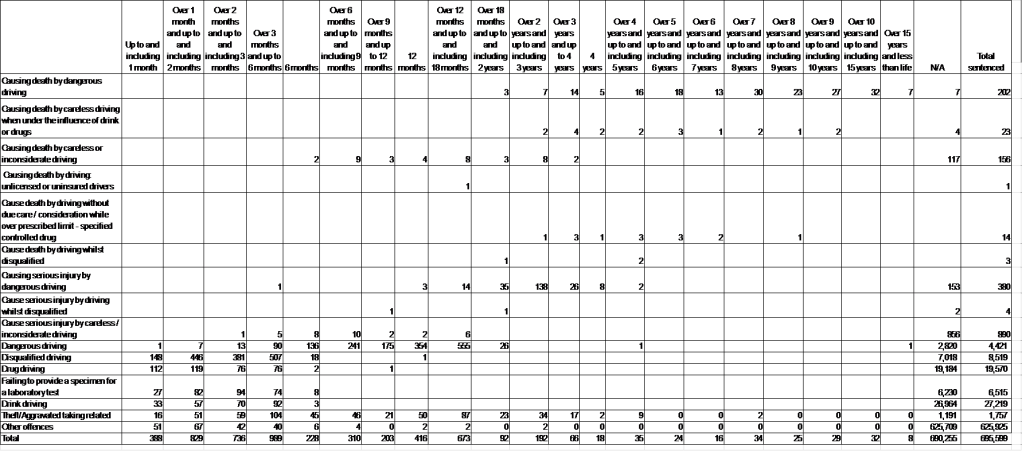
Source: MoJ (2025) https://www.gov.uk/government/statistics/criminal-justice-system-statistics-quarterly-december-2024
[1] The 192-page report included one reference to motoring offences, i.e. how fines were most commonly given with motoring offences.
 actionvisionzero.org