30th March 2026
Key points
- The Sentencing Act 2026 requires a rethink of how serious motoring offences are sanctioned.
- As of this week, the Sentencing Act 2026 has introduced a presumption against the use of short custodial sentences (12 months and under).
- This affects 77% of the custodial sentences given for motoring offences – mainly for unsafe driving that was intentional, dangerous and disqualified driving.
- Prison will now only be used in cases where death or serious injury has been caused by dangerous driving or careless driving involving drink/drug driving.
- The Department for Transport’s (DfT) Motoring Offences consultation offers a real opportunity to introduce sanctions that are more effective at deterring the forms of unsafe driving.
Introduction
Whilst motoring offences account for 60% of sentences given at court, because so few result in a custodial sentence (less than 1%), they receive scant attention from the criminal justice system reforms which are focused on reducing the use of prison. Yet the Sentencing Act 2026 will have a significant impact on the deterrence of the worst examples of driving. Prison will no longer be an option in most cases.
See Table 1 below for data on the number of custodial sentences given and their length, from the Ministry of Justice Criminal Justice Statistics (2025).
Presumption against short sentences
The new presumption against custodial sentences of 12 months and under will have a major effect on the motoring offences involving custodial sentences. This includes:
- 77% of motoring offences.
- Almost two-thirds of cases involving Dangerous Driving (64%).
- Almost half of sentences given for Causing Death by Careless Driving (46%) and 82% of Causing Serious Injury by Careless Driving.
- All custodial sentences given for drink/drug driving, Fail to stop and any other summary offence that has a maximum custodial sentence length of six months.
AVZ comment
Although it was almost never used, some still saw prison as a deterrent to unsafe driving. The Sentencing Act 2026 should be a wake-up call. In the future a prison sentence will be even more of an exception. With these changes, tougher sentences for motoring offences now need to include home curfews, community sentences, vehicle confiscations and longer disqualifications.
DfT’s Motoring offence consultation is quite timely. Whilst the consultation, open until 11th May, does not cover Dangerous Driving (or other moving offences such as speeding, careless driving, using a mobile phone, traffic signal violation), it does ask about tougher sentences for Fail to Stop and Disqualified Driving, as well as the use of vehicle confiscation. This is a real opportunity to start the discussion and reform of sanctions with greater use of out of court penalties, and focus more on deterrence and rehabilitation.
Table 1: Motoring offences custodial sentence length (2024), England and Wales
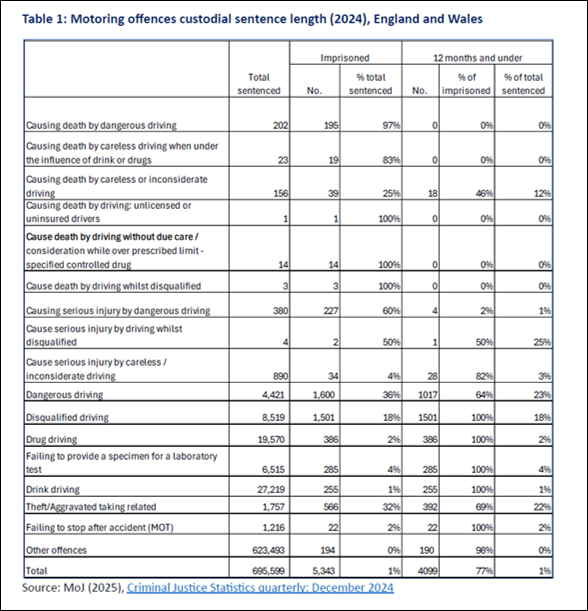
Source: MoJ (2025), Criminal Justice Statistics quarterly: December 2024
 actionvisionzero.org