16th May 2024
To download this briefing as a pdf click here
Key points
- The Sentencing Council is consulting on their first Disqualification Guideline.
- Bans (disqualifications) are a key sanction for reducing road danger, with our penalty points system based on the deterrent effect of bans.
- The draft Guideline summarises existing policy but offers no encouragement or even recognition of the key role bans have in getting unsafe drivers off our roads.
- Bans are given where mandatory (e.g. drink/drug driving) and for “totting up” of penalty points, but are very rarely given where discretionary. For example:
- 1. More than 9 out of 10 speeding offences are sanctioned out of court, but of the few that make it to court (and these will include extreme speeders) only 1.7% are banned.
- 2. Despite the well-known overlap with dangerous driving (where disqualification is mandatory), only 5% of careless driving offences convicted at court are banned.
- AVZ has provided key points and statistics on disqualifications by magistrates court geographical area to show how few discretionary bans are given where you live.
- Please respond to this short consultation either by email to consultation@sentencingcouncil.gov.uk or (easier) via the online survey and urge the Sentencing Council to take a more proactive approach to disqualification. Consultation closes next Wednesday, 22 May.
Background
Two years ago, the Sentencing Council consulted on guidelines for serious motoring offences, including causing death and serious injury by driving. This consultation touched upon disqualification but focused on custody and community sentences. There was strong demand from professionals and campaigners for more information on disqualification. This led to the Sentencing Council now consulting on their first ever Disqualification guideline.
Unfortunately, as AVZ has previously pointed out, the draft Disqualification Guideline is little more than a clarification of existing policy and not a new approach with greater use of disqualifications. Sentencing has several purposes and disqualification ticks several of them – public protection, punishment and deterrence. Bans are the key sanction for road danger reduction campaigners and have a key role in enforcement as the penalty points system relies on them being a deterrent.
Please respond to this consultation and urge the Sentencing Council to do more and better. Here are some key points to consider and do use the data provided on bans given in your local area. See here for the excel spreadsheets for the tables provided at the end of this briefing.
How to respond to the consultation
- Choose to respond to the consultation a) by email to consultation@sentencingcouncil.gov.uk OR b) probably more easily via the online questionnaire
2. Fill in the Introductory questions 1 to 4.
3. Note: most of the consultation is focused on aggravated vehicle taking offences and there is no need to answer those questions. Move along to the section titled Driver disqualification and respond to questions 15 to 19 (see below for some suggestions as to how to respond and issues to raise).
Question 15—Availability. Do you agree with what the guideline says re how disqualifications can be used?
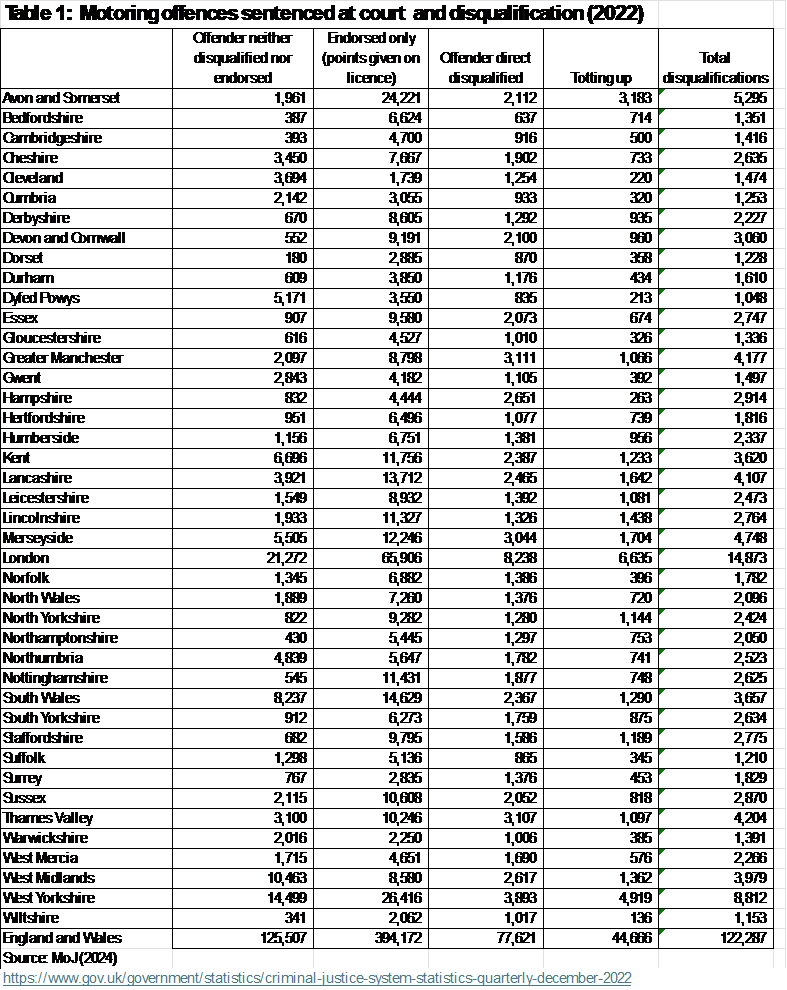
No. We need the Sentencing Council to make better use of disqualifications to reduce illegal and unsafe driving. At present, bans are given where required – either where mandatory (61,805 and 51% total) or with totting up (44,666 and 37%), where 12 penalty points have been reached. Very few bans are given to drivers convicted of offences where disqualification is discretionary, including speeding and careless driving. In 2022, only 15,816 bans were given where it was discretionary. This was only 3% of the 534,799 offences sentenced that could have had a discretionary ban.
See Table 1 to see how many disqualifications were given in your area in 2022. Most of these will be for drink/drug driving offences (Table 2). Table 3 and 4 shows how few bans are given for drivers convicted of individual cases of speeding and careless driving. The number of bans given with totting up are also shown and refer to the offence which took the penalty points to 12 or over.
Question 16. Do you agree with what the disqualification says re considering bans and their length?
No. The questions posed (for sentencers to consider) discourage the use of bans. No question asks about where the offence occurred, i.e. on a busy street shared with pedestrians and cyclists with the increased risk posed to others.
Questions in the draft Disqualification Guideline for sentencers to consider
How bad was any driving concerned in the present offence?
Does the offender have a history of poor driving, driving unlicensed, or breaching disqualifications?
Will the public be at risk of harm from the offender’s driving in future?
Will the disqualification period provide a sufficient deterrent to the offender, helping to ensure their future driving is of an acceptable standard?
How will the disqualification affect the offender’s prospects for rehabilitation (with particular regard to employment, training, and family responsibilities)?
What will the impact be on third parties (including children and dependent family members) for the duration of the disqualification?
What is the aggregate period that the offender will be prevented from driving, bearing in mind any period spent in custody?
Standing back, is the disqualification fair and proportionate, considering the culpability of the offender and the harm done?
Re length of bans, it is not enough for the draft guideline to say the “there is nothing in principle in preventing the courts from imposing lengthy disqualifications of several years”. In reality, bans are short. Only 1% are five years or longer, with an average of just one lifetime ban given every year.
The last consultation by the Sentencing Council did not include any questions on increasing ban length for serious motoring offences (causing death and serious injury by driving, dangerous driving).
Question 17. Do you agree with what the guideline says re exceptions?
There are two types of exceptions
- Special reasons where mandatory bans are not given. This is very rare (1%).
- Exceptional hardship. The MoJ’s statistics show the number of totting up bans given has increased in recent years. But the Sentencing Council has yet to research the effectiveness of their guidance issued on Exceptional Hardship in 2020. The number of pleas still being accepted is not known and could have risen along with the overall number of totting up bans.
Question 18. Do you agree with what the guideline says re administration?
Yes. This includes disqualification periods being reduced for drink drive offenders who have completed a rehabilitation course. We expect this to be extended to drug driving if the evidence shows that it reduces re-offending.
Question 19. Any other comments?
Bans are the key sanction for reducing road danger. And their role will increase if the government ends the use of prison sentences of 12 months or under. At present, 84% of custodial sentences given for motoring offences are 12 months and under. So, we need this Guideline to promote the use of disqualifications, especially with speeding and careless driving.
We also need the Sentencing Council to:
- Consult on the Magistrates Courts Sentencing Guidelines on key offences, especially speeding and careless driving.
- Consult on longer disqualifications to be given for causing death and serious injury by driving and dangerous driving.
- Conduct research on the effectiveness of their Exceptional Hardship guidance and strengthen it if needed.
- Appoint a Transport Advisor (motoring offences accounted for 61% of those sentenced at court in 2022).
If you would like to see the AVZ response to the consultation, please contact amy@actionvisionzero.org.


 actionvisionzero.org