September 2025
Download this briefing as a pdf here
Key points
- London through TfL and the GLA has led the country on reducing road danger in Britain, e.g. 20mph limits, Direct Vision Standards with lorries, and speed limiters in buses and TfL’s fleet. But to be complete, the picture should include work by the police as well. Yet the statistics show the Metropolitan Police (Met) are lagging behind, rather than leading, on traffic law enforcement for three offences that are key to reducing road danger.
- Based on offences completed, per person Killed and Seriously Injured (KSI) for 2023, amongst the 40 police services, the Met ranked:
- 16th for speeding offences
- 13th with careless driving offences
- 7th with mobile phone offences.
- If the Met had performed as well as the leading police services, there would have been:
- Four times as many speeding offences
- Twice as many careless driving offences
- Three times as many mobile phone offences.
- London has invested in speed enforcement and the 2024 stats should show improvement by the Met. But no such progress is expected with careless driving and mobile phone offences, the offences most likely to be reported by the public.
- AVZ call: The next London Vision Zero Action Plan should include the aim of the Met leading the country in enforcement of speeding, careless driving and mobile phone use. This will require investment in both speed enforcement and public reporting of road crime.
Enforcement comparison – key offences on a per KSI basis (2023)
Here the amount of enforcement conducted by the Met is compared with other police services. The comparison is for three offences key to reducing road danger: speeding, careless driving and mobile phone offences. The comparison is for 2023, the most recent year where there is motoring offence data available for completed offences.
Data is from the Home Office (HO) and the Ministry of Justice (MoJ). The MoJ reports motoring offences involving arrests whilst the HO reports all other offences. The HO reports over 80% of motoring offences.[1]. The MoJ reports in May but the HO does not publish its annual statistics until October at the earliest. A comparison for 2024 will be produced after the HO publishes its data in 2025.
And to be clear, the comparison is based on the offences sanctioned out of court and those convicted at court. This is different from the London Vision Zero Enforcement Dashboard (LVZED) which shows offences started, i.e. including offences later cancelled. This amounted to 47% of speeding offences reported by the LVZED in 2023.
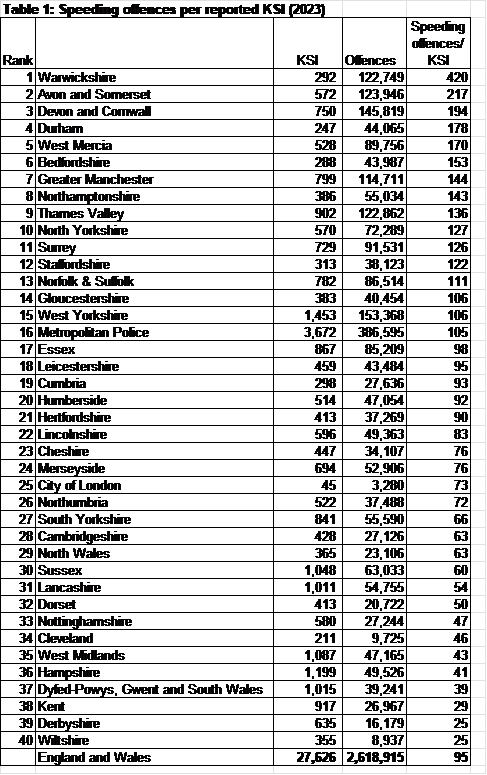
Speeding (Table 1 below)
Compared to other police services, with 386,595 speed offences completed in 2023, the Met came out 16th, with 105 speeding offences per KSI. Warwickshire led with 420 speeding offences per KSI.
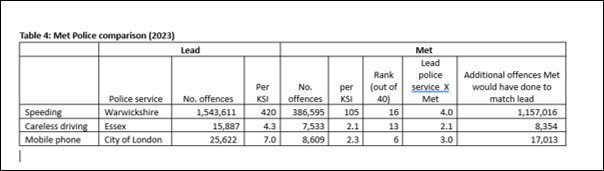
If the Met had done as much speed enforcement as Warwickshire (on a per KSI basis), there would have been four times as much enforcement. This would mean over another million offences (1,157,016) for a total of 1,543,611. But it should be noted that the Met has increased its speed enforcement since 2023 and should score higher in 2024.
Careless driving (Table 2 below)
With 7,533 careless driving offences completed in 2024, the Met ranked 13th with 2.1 offences per KSI. Essex reported the highest with 4.3 careless driving offences per KSI, double that of the Met.
If the Met had enforced careless driving as Essex did (on a per KSI basis), another 8,354 careless driving offences would have been sanctioned, for a total of 15,887.
Mobile phone (Table 3 below)
In comparison, the Met fared better with mobile phone offences. Here, with 8,609 mobile phone offences completed in 2023, they ranked 7th with 2.3 offences per KSI. Their neighbour, the City of London Police, ranked highest with 7 offences per KSI, three times that of the Met.
If the Met had sanctioned mobile phone offences at the rate that their neighbour, the City of London Police, had done, there would have been another 17,013 mobile phone offences, for a total of 25,622.
AVZ call
The London Vision Zero Action Plan is based on road danger reduction and is a joint strategy with the Met. London has done much groundbreaking work on reducing road danger, including installing Intelligent Speed Assistance (ISA) in its buses and TfL’s own fleet of vehicles. Speed enforcement over the last five years has greatly increased. See Table 4. London also deserves praise for the expansion and enforcement of 20 mph limits.
But as shown above, more is needed, especially with speed enforcement and careless driving. The next London Vision Zero Action Plan should include the aim of London leading the country on enforcing the key offences of speeding, careless driving and mobile phone use—all key to reducing the harm posed to people walking and cycling.
Data sources
HO (2024) Fixed penalty notices (FPNs) and other outcomes for motoring offences statistics
Note: Data can be accessed here
[1] In London, court prosecutions for offences detected by the City of London Police are classified under the Metropolitan Police. This increases, i.e. inflates, the offences sanctioned by the Met but by a small amount.
Tables:


 actionvisionzero.org