England and Wales (2022-2024)
15th April 2026
To download this briefing as a pdf click here
Key points
- In collisions between cycles and cars in England and Wales (2022-2024), DfT stats[1] show that:
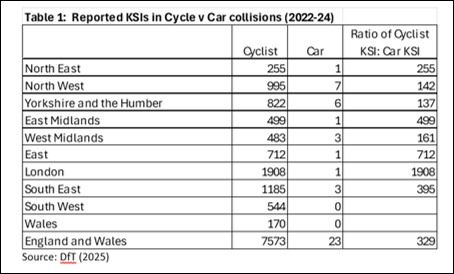
- There were 7,573 cyclists killed and seriously injured (KSI) compared to 23 car occupant KSIs
- Thus the cyclist was 329 times more likely to be killed and seriously injured than a car occupant.
- Such inequity could be mitigated with reforming our civil compensation system and adopting a presumed liability basis.
That cyclists are more likely to be hurt in collisions with motor vehicles than the vehicle occupants should surprise no one. But the data highlighted here serves as a reminder of just how extreme the inequity is between these two modes sharing the road, if not the risk. This briefing is part of AVZ’s Who’s Getting Hurt series which highlights the inequity of risk in road travel.
Source: DfT (2025)
By police region (Table 1)
- Two police regions (South West and Wales) reported no car occupants seriously injured in a collision with a cycle, although there were 714 cyclist KSIs.
- The other eight police regions had a total of 23 car occupant KSIs and 6,859 cyclist KSIs.
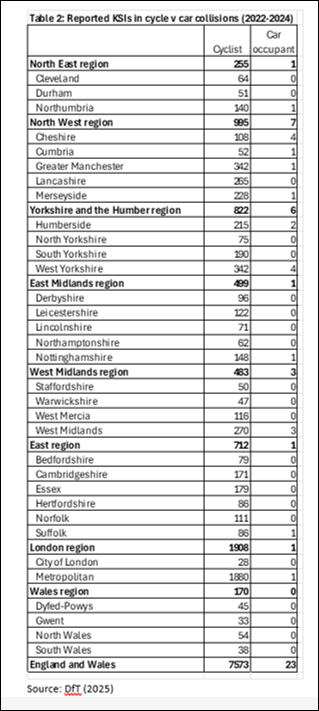
By police service (Table 2)
- Over half of police services (23) reported no car occupant KSIs in a collision with a cyclist during this three year period, but they reported 2,303 cyclist KSIs in these collisions.
- Cheshire and West Yorkshire reported the highest number with each reporting four car occupant KSIs compared to 108 cyclist KSIs and 342 cyclist KSIs respectively.
- The Met reported two car occupant KSIs and 1,880 cyclist KSIs—the latter over five times the numbers of cyclist KSIs reported in Greater Manchester (342) where there was one car occupant KSI.
Source: DfT (2025)
AVZ comment
The Road User Hierarchy was introduced in The Highway Code in January 2023 to increase the care road users showed towards those who are more vulnerable on our roads. This has yet to show any impact. DfT’s new Road Safety Strategy acknowledges that the burden of road collisions is not equally distributed. But more can be done to reduce this inequity. A civil compensation system based on presumed liability, as other countries already have, would help by ensuing injured pedestrians and cyclists were able to access compensation. In 2018, the government’s response to the Call for Evidence on the Cycling and Walking investment Strategy, said research would be commissioned to understand the pros and cons of adopting a presumed liability system. Eight years on, this is still outstanding and needed more than ever.
[1] Thanks to Robin Tucker of Active Travel Café, Coalition for Healthy Streets and Active Travel (Oxford) for analysing the DfT data and making this comparison possible.

